


Ref. 2165
M. Planchon
Clock-maker (1842-1921)
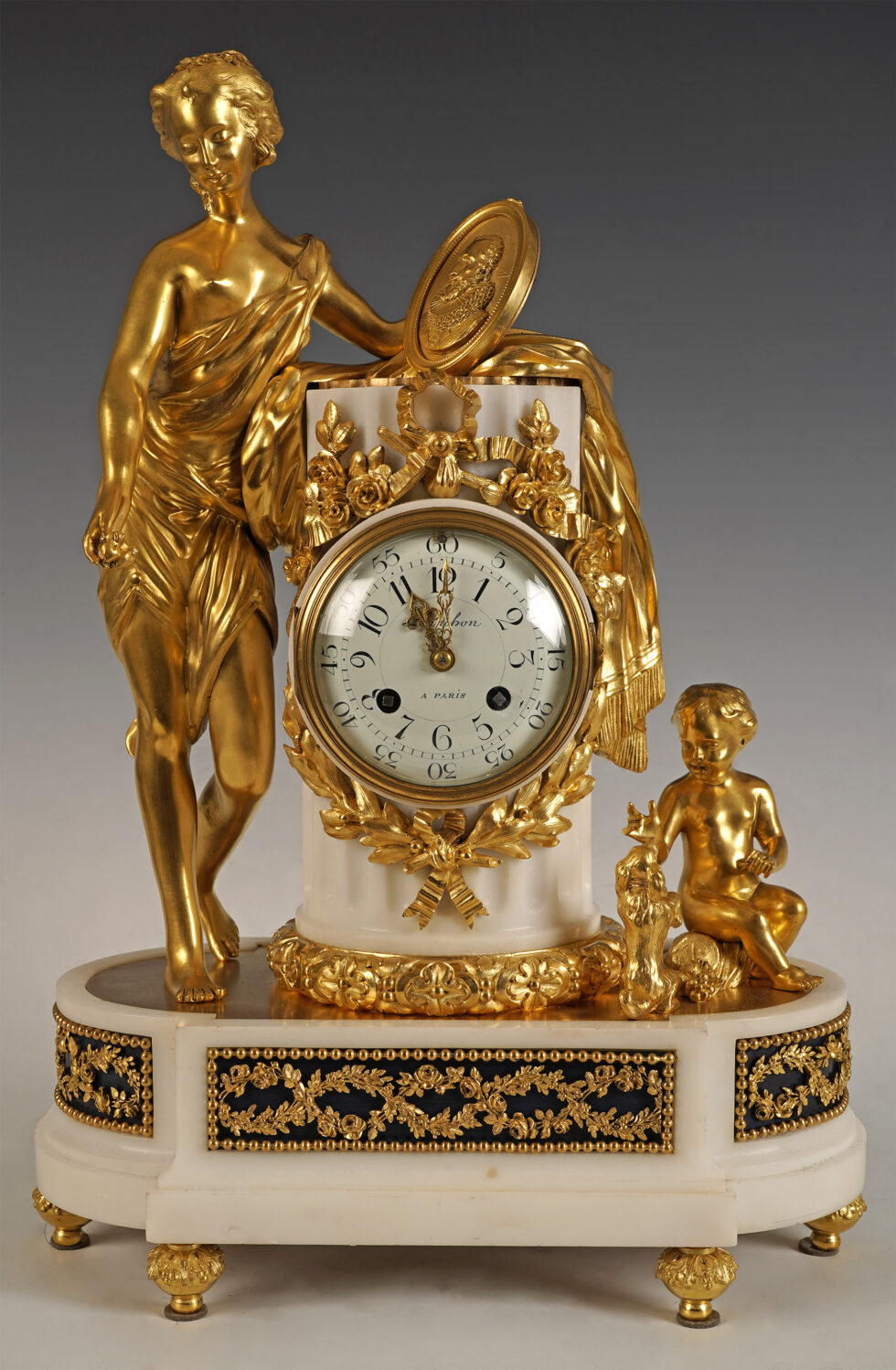
«Allegory of Fidelity to Henri IV»
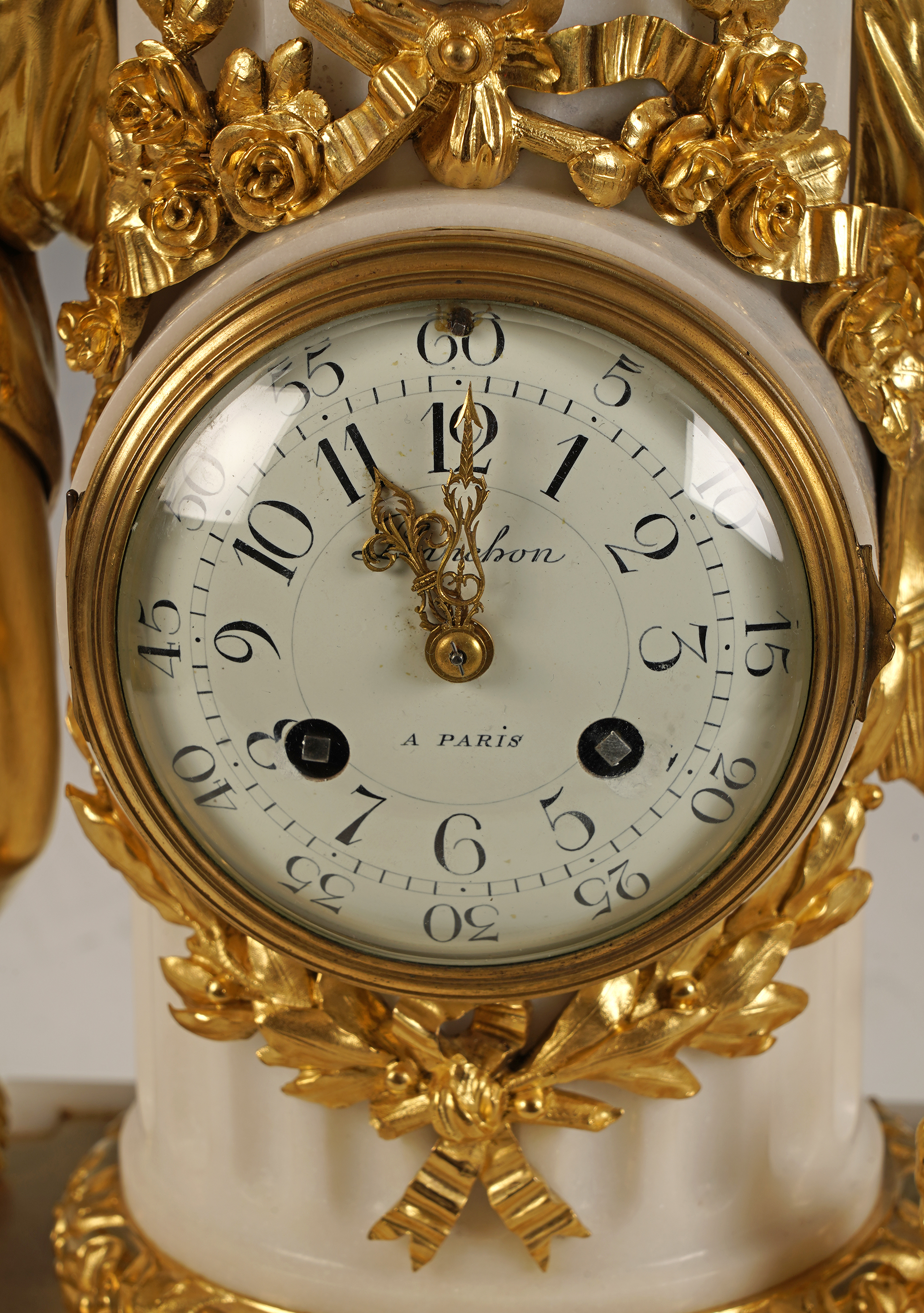
Dial signed « Planchon à Paris »
France
Circa 1880
Gilded bronze, Marble
Height : 46 cm (18,1 in.) ; Width : 30 cm (11,8 in.) ; Depth : 17 cm (6,7 in.)
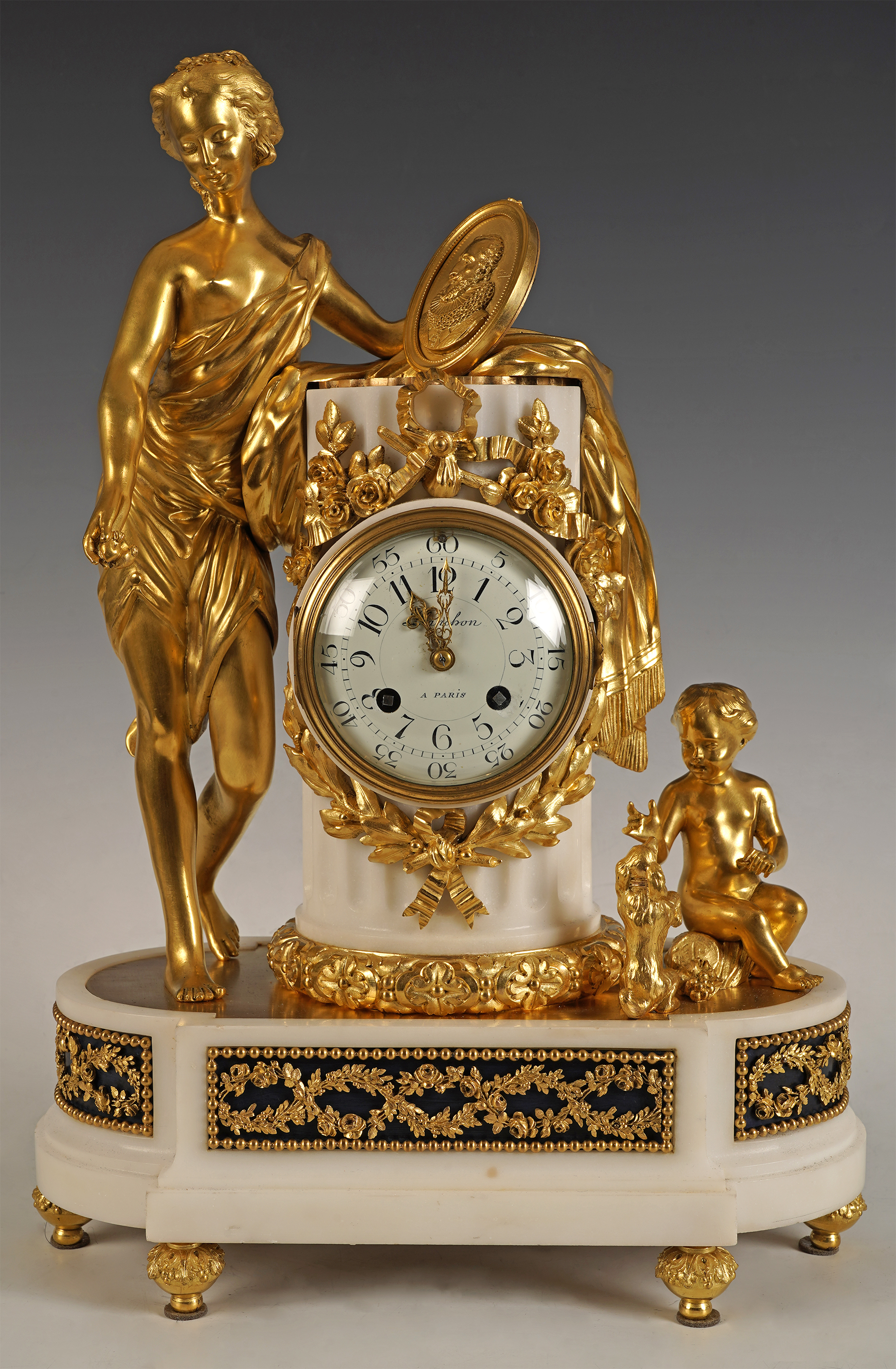
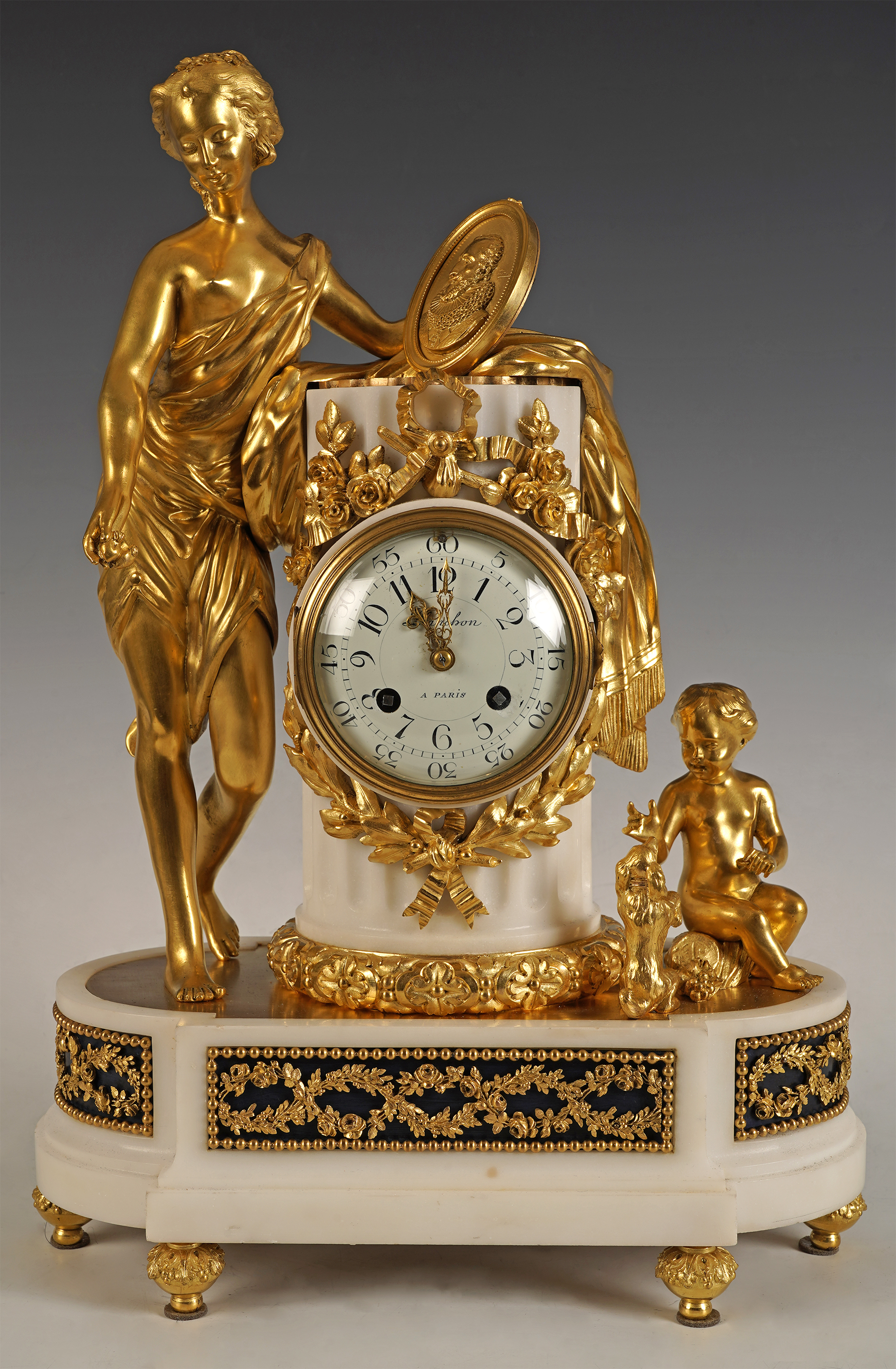
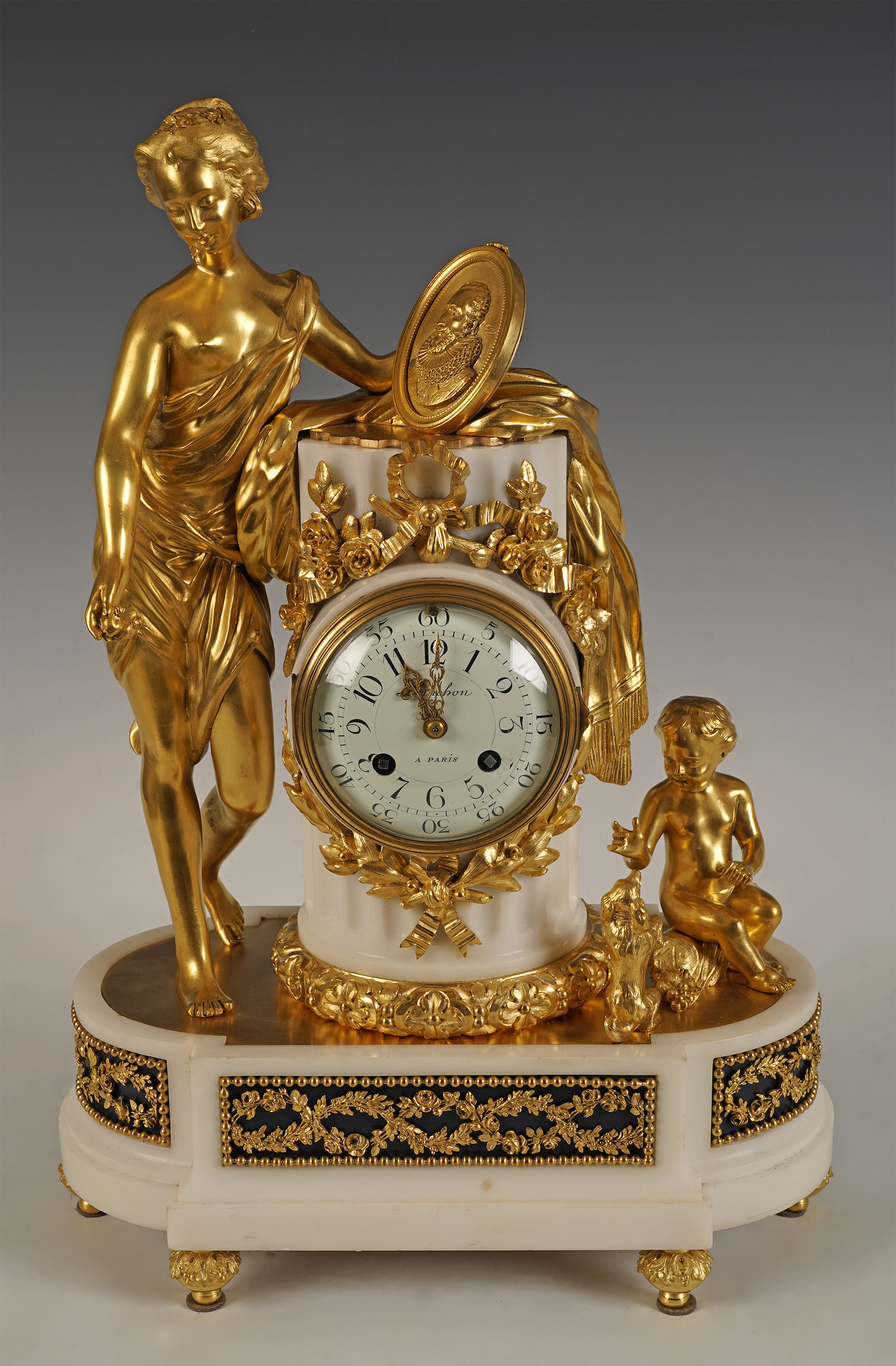
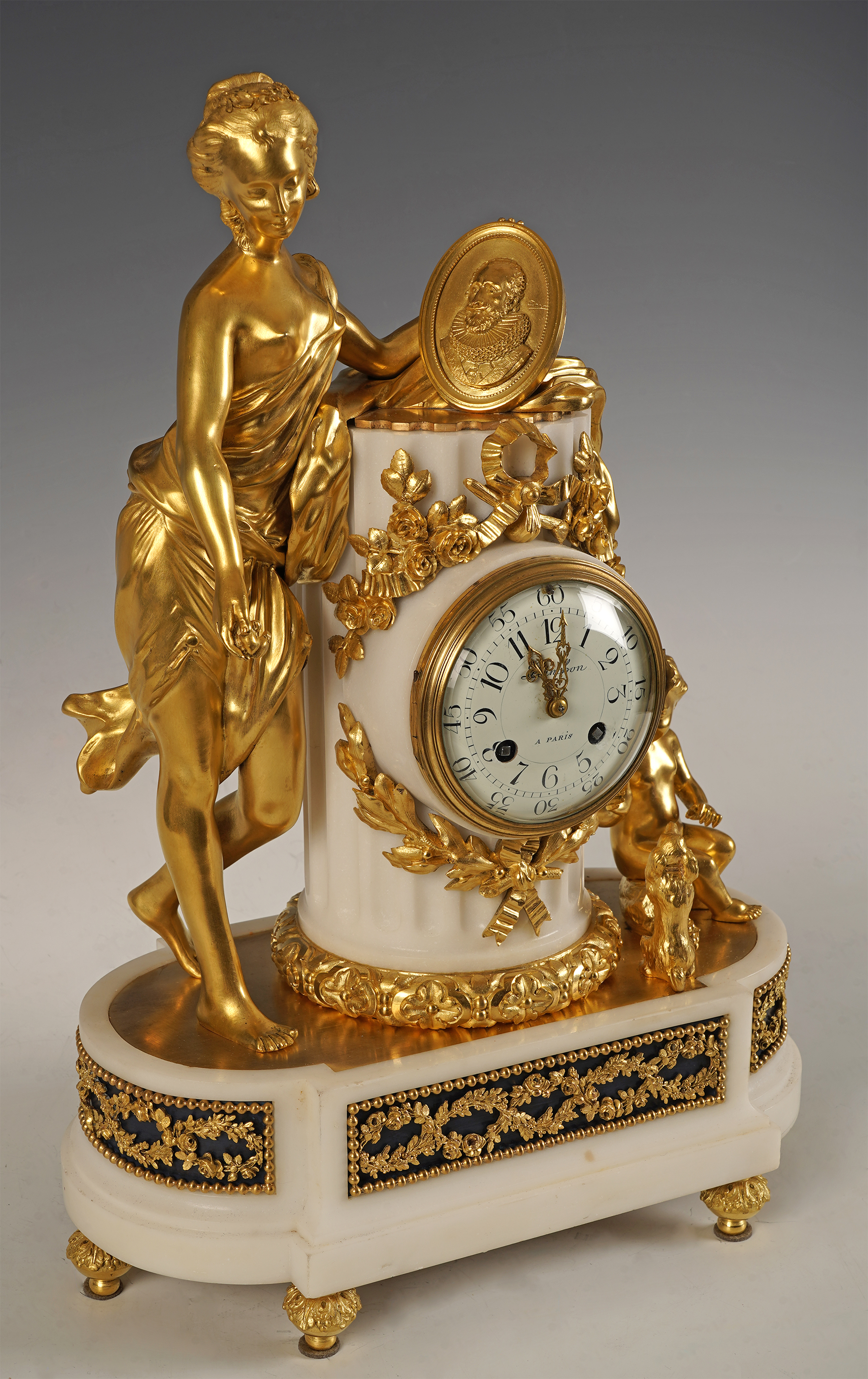
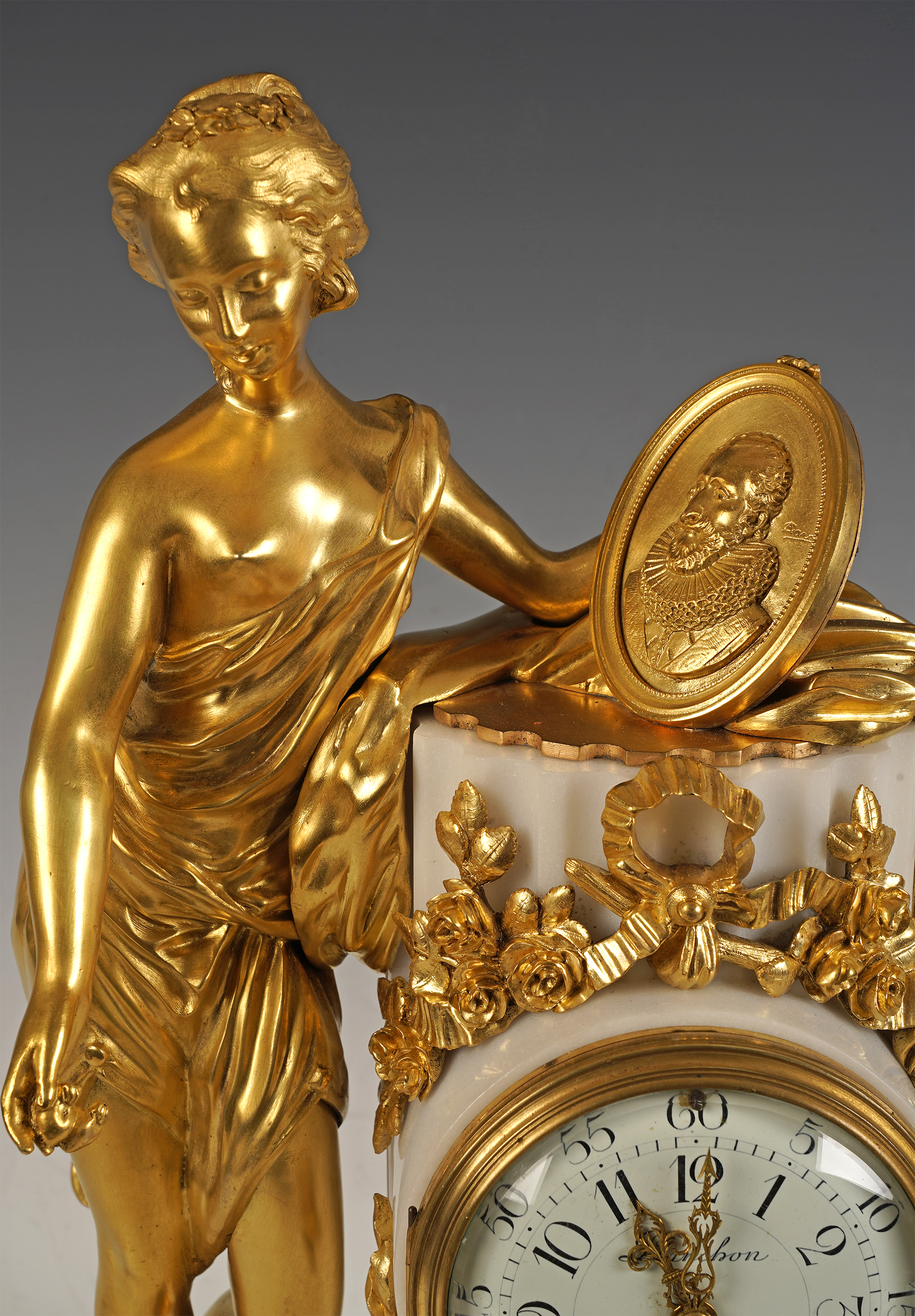
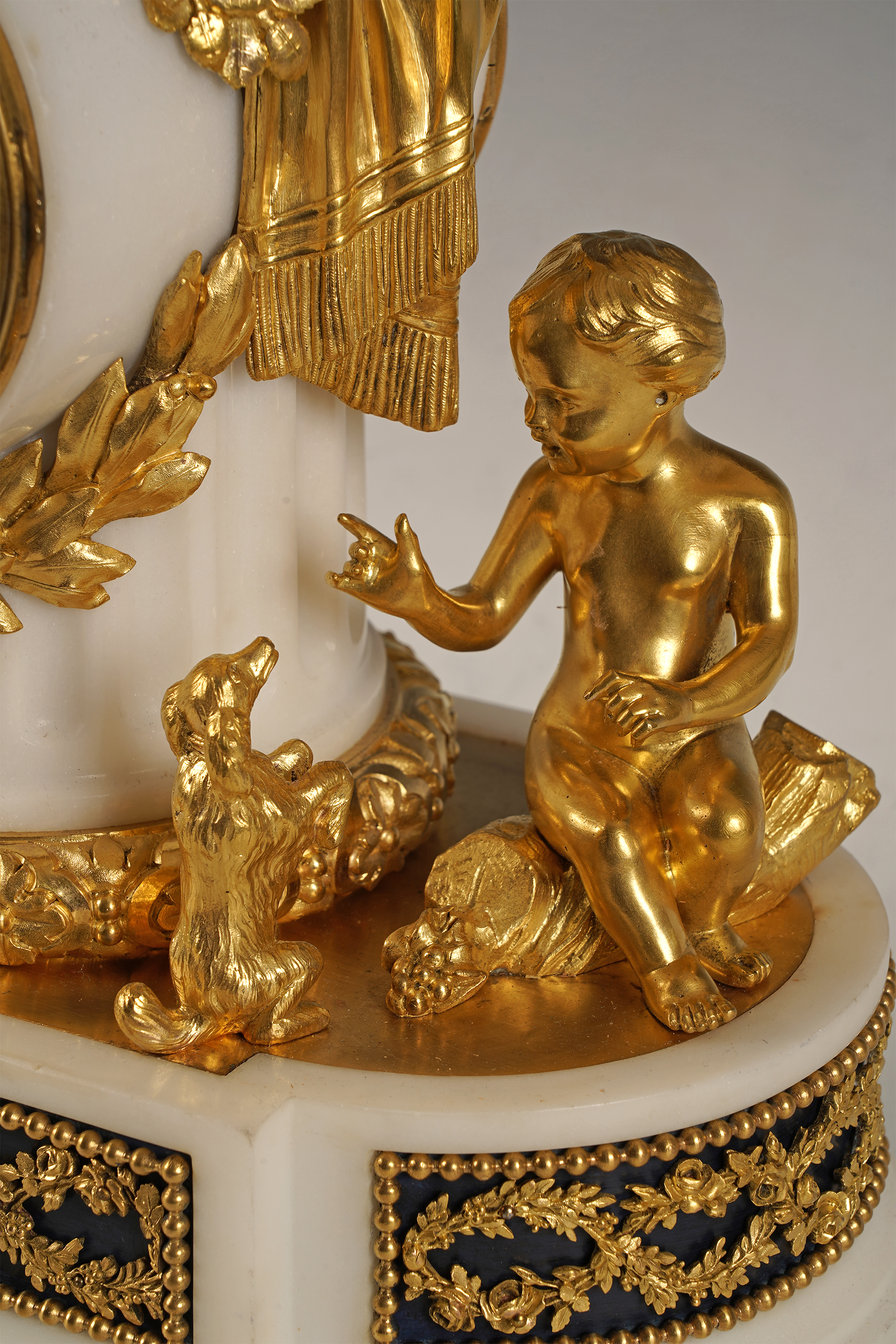
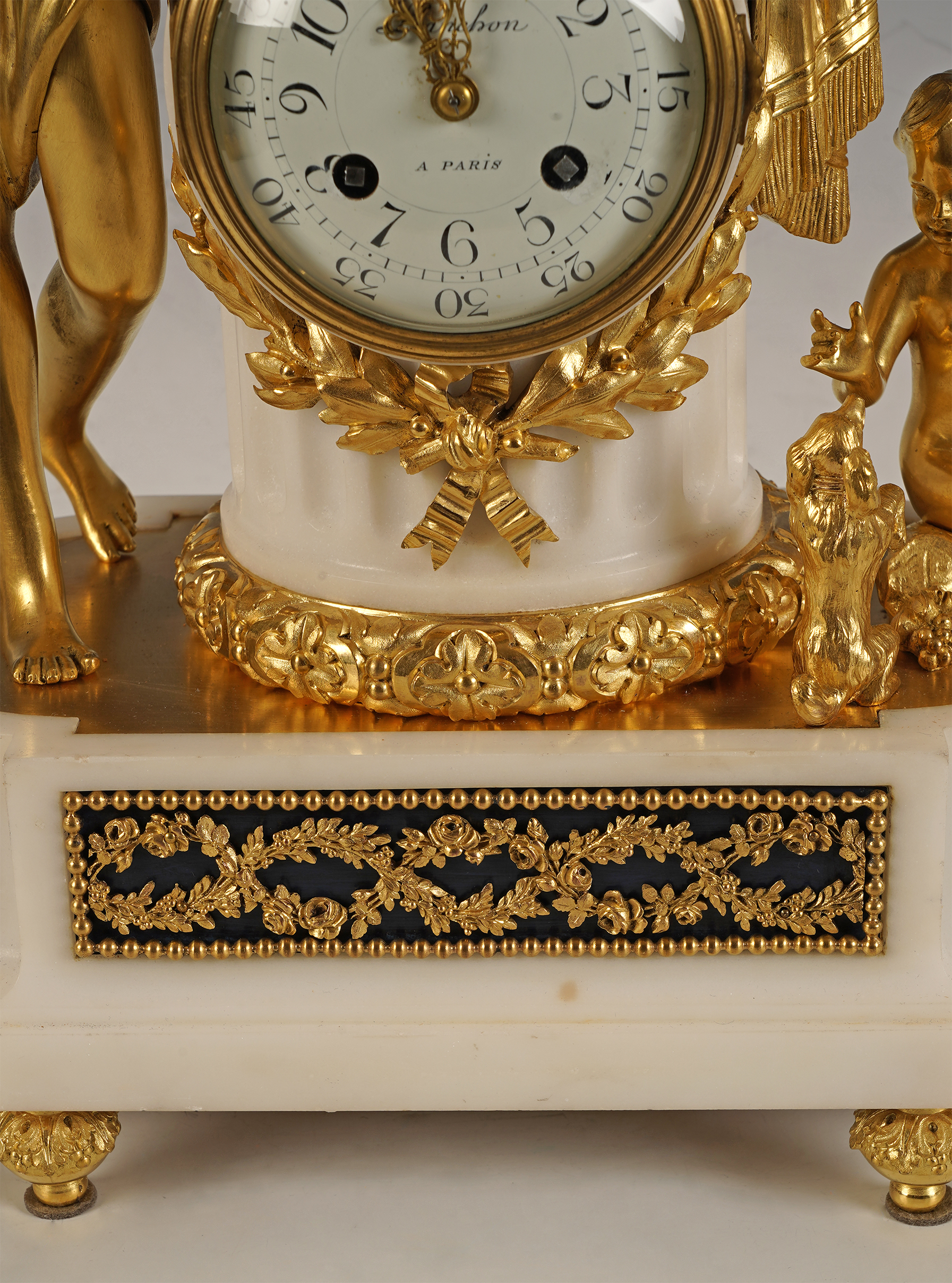
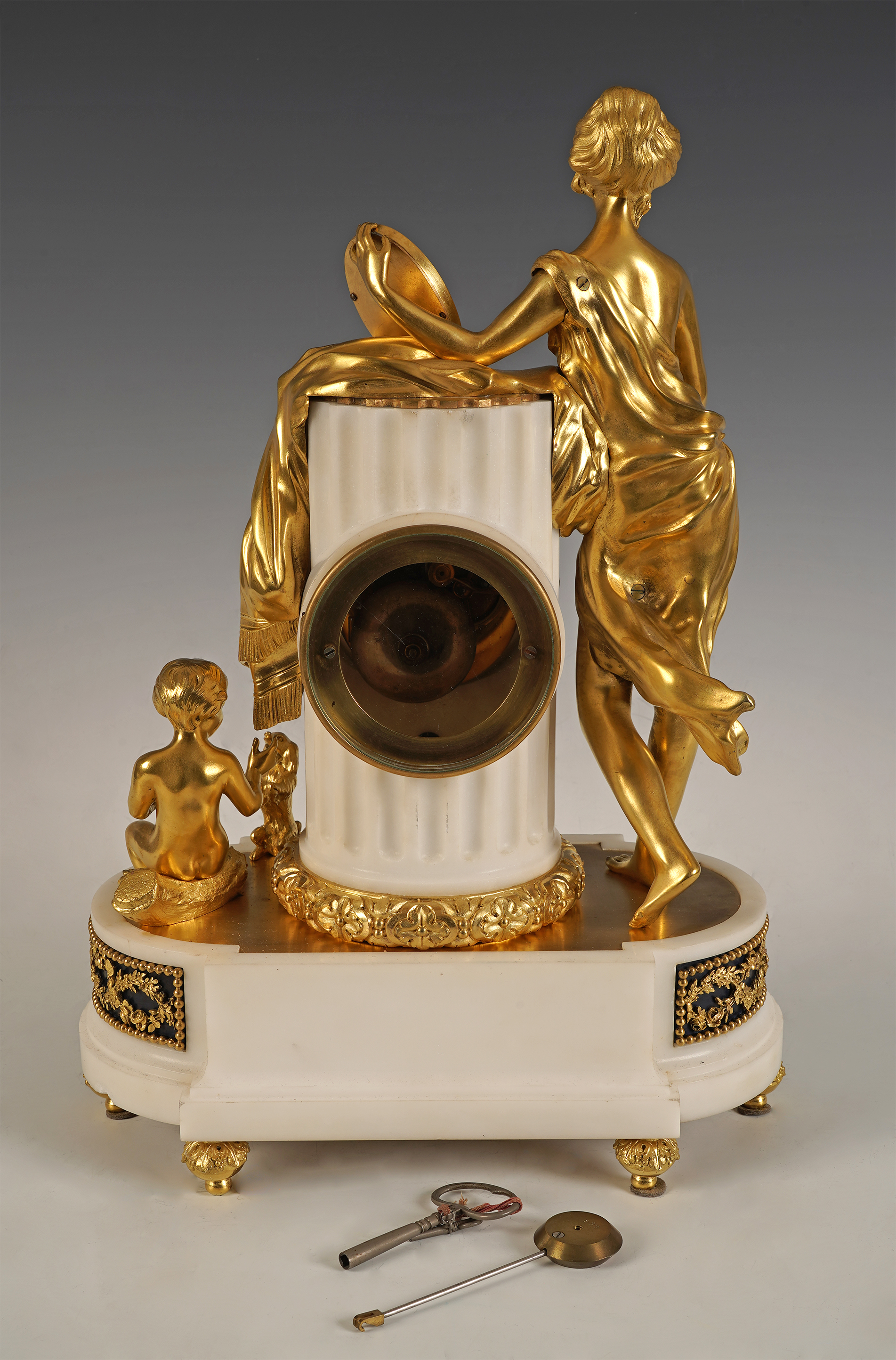
A fine clock in white marble and chased and gilt bronze, depicting a female figure draped in the antique manner, holding two hearts in her right hand and supporting a medallion bearing the profile of Henry IV of France, an idealized royal figure. This medallion rests on a truncated, fluted marble column housing an enamel dial with Arabic numerals for the hours and a peripheral minute track, framed by a knotted garland of flowers and laurel. To the right, a child playing with a dog forms an explicit symbol of fidelity (the dog being the traditional attribute of this virtue).
The whole rests on a molded base decorated with garlands of roses and laurel within beaded reserves on a black ground, supported by six leafy ball feet.
This association makes it possible to interpret the composition as an allegory of fidelity to Henry IV, a king regarded in the 18th century as a model of good governance and national concord.
This theme belongs to a well-established iconographic tradition: clocks from the late Ancien Régime frequently employ female and childlike figures to express moral or political virtues. This clock represents a historicist revival of a model designed in the 1780s, a period when Parisian clockmaking reached a peak in the integration of sculpture, architecture, and moral symbolism.
related work
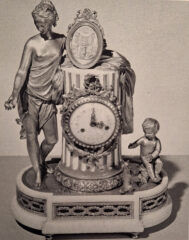
This model, highly popular in the 18th century and probably created by the merchant-mercier Daguerre, was produced in numerous variations on different themes, such as this Allegory of Friendship and Loyalty clock, signed “Montjoye à Paris,” circa 1780, now in the Philadelphia Museum of Art (reproduced in H. Ottomeyer, Vergoldete Bronzen, vol. I, Klinkhardt & Biermann, Munich, 1986, p. 245).
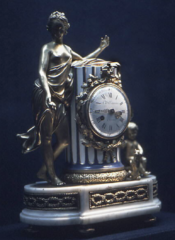
The Metropolitan Museum of Art in New York also holds an example signed “Charles Dutertre à Paris,” on which the medallion is missing (inv. no. 43.163.24a–b).
biography
Matthieu Planchon (1842–1921), born in Bourges, was apprenticed to his father, also a clockmaker, and completed his tour de France in 1862. He acquired the business of the clockmaker Adrien Philippe in 1870. Listed on Rue Vieille-du-Temple in 1880, by 1890 he had established himself in the Galerie Montpensier at the Palais-Royal. Influenced by the architect Viollet-le-Duc (1814–1879), he specialized for a time in the Neo-Gothic style before developing a style known as the “Planchon style,” inspired by those of the Ancien Régime.
In 1889, he adopted as his trademark the motto of 17th-century Parisian clockmakers: Solis mendaces arguit horas (“The hours of the sun are deceptive”). In 1899, he took on his son-in-law, Paul Brateau, as a collaborator. He published several works and, in 1900, wrote the report on the Retrospective Museum of the Exposition. He died in 1921. Brateau succeeded him, and the shop, located on the Chaussée d’Antin since 1900, was moved in 1930 to Rue Meyerbeer, where it ceased all activity in 1936.
bibliography
- Tardy, Dictionnaire des Horlogers Français, Paris, 1972, p. 525
Contact us
Related Items

Elkington & Co
Easel Clock
F. Linke
Thermometer Calendar

Ormolu Clock with a swing
L’Escalier de Cristal
“The Musician” Japanese style Clock
M. Planchon
“Allegory of fidelity to Henri IV”
G. Servant
Neo-Egyptian Clock

G. Denière
“Cage” Clock
H. Dasson
Barometer Thermometer

E. Hazart
A Charming Clock

Millet
Exceptional rotating clock
Tobogan Newsletter
If you want to be up-to-date with our new acquirings you can sign up to our newsletter.